Historical source and event dates are not site publication dates. Product plans, policies and availability may have changed since retrieval.
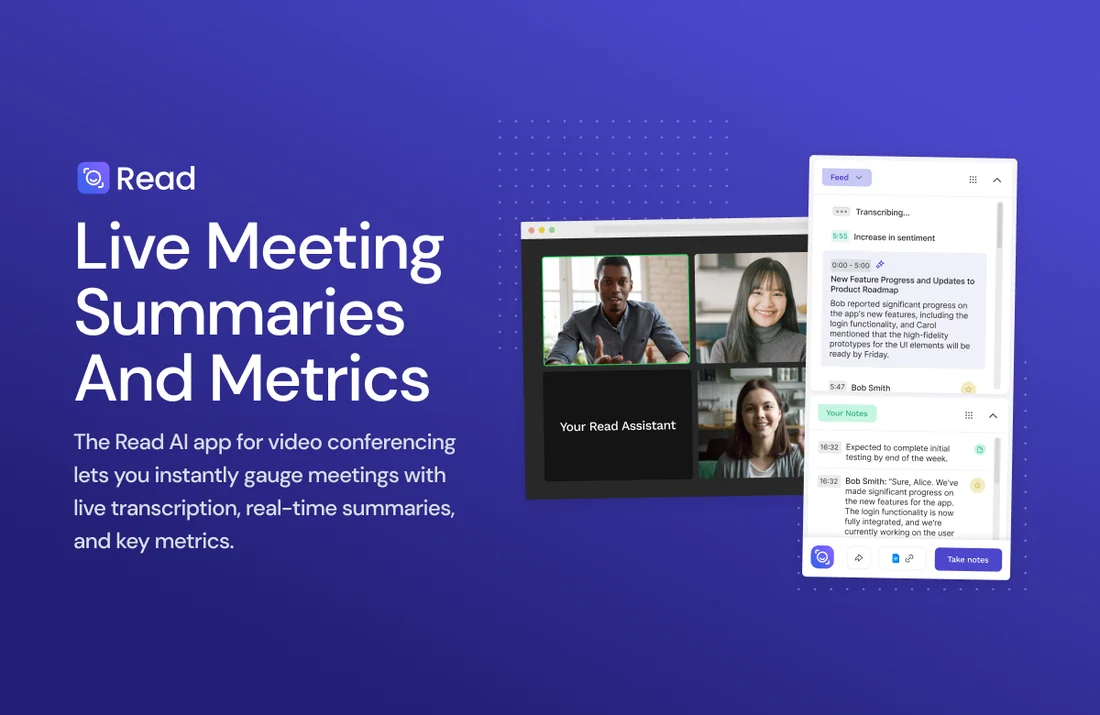
The setup
Read AI joins a call the way most notetaker bots do, through a calendar connection or platform integration, but it markets a second layer beyond notes: metrics about how a meeting itself went, drawn from participants' voices and video. Turning that layer on means enabling the product at all, since Read's own meeting-tools page describes the analytics as part of the same real-time session as the notes, not a separate opt-in most users would think to look for.
What the documents show
The meeting-tools page states that Read measures the verbal and non-verbal cues in a meeting and translates that into real-time and post-meeting sentiment and engagement metrics, and separately tracks talking speed and filler-word usage during the meeting. Read's own privacy policy defines the underlying construct precisely: it uses audio and visual information to score a user's affect and behavior during meetings and to produce analytics, like individual talk times and an overall metric on how well a meeting went based on inferred reactions and engagement, which it calls a Read Score. The same policy states this scoring is shared with other meeting participants in real time, not kept private to the person being scored. A separate feature, Speaker Coach, draws on a person's own past meetings for a different purpose and is described in Read's own materials as producing customized, private metrics on clarity, inclusion, and impact for that individual alone.
The friction
The privacy policy also discloses that Read derives demographic inferences from the same audio and visual data to improve its models and increase the accuracy of its analytics, a use disclosed in the policy rather than on the product pages describing the feature itself. Opting out mid-meeting is described as typing opt out into the meeting chat, or removing Read the way any other participant would be removed; if chat is disabled, only the host can remove it from meeting settings, which puts the practical ability to stop the scoring in the host's hands, not every attendee's.
What changed in the work
Before tools like this, a meeting's tone or an individual's talk time was something a facilitator judged informally, if at all. What the documents support is that Read AI turns that judgment into a number, attaches it to individual participants, and, for the Read Score specifically, shares it with the room rather than only with the person it describes. Labelled as editorial, the setup decision this creates is different in kind from turning on notes: it is a decision to measure people, not just the content they produced, and the privacy policy's own language is the clearest evidence of that scope.
- Is the shared Read Score turned on for this workspace, separately from the private Speaker Coach metrics?
- Do participants outside the host's own organization know their talk time and engagement will be scored?
- Has anyone reviewed what demographic inferences the analytics pipeline draws from meeting audio and video?
The distinction Read's own documents draw, between a private coaching metric and a shared meeting score, is the one a team actually has to decide on before turning either feature on.
Sources & verification
Preserved from the earlier archive. These sources have not all been freshly rechecked for this expansion.
- Meeting Tools, Real-Time Meeting Navigation, CoachingSource date: not stated · Retrieved: 2026-09-16
States that Read measures verbal and non-verbal cues to produce real-time and post-meeting sentiment and engagement metrics.
- Read AI Privacy PolicySource date: not stated · Retrieved: 2026-09-16
Defines the Read Score, states analytics are shared with other meeting participants, discloses demographic inference, and describes the in-meeting opt-out.
- Coaching: Your personal AI Speaker CoachSource date: not stated · Retrieved: 2026-09-16
Describes Speaker Coach metrics on clarity, inclusion, and impact as customized and private to the individual, unlike the shared Read Score.
Continue the workflow
- Review a shared-inbox draft without colliding or sending early
A small-team shared-inbox routine that prevents duplicate replies, context leakage, approval confusion, and accidental sends.
- Reconcile meeting actions across a recurring series
A method for resolving duplicate, changed, and conflicting action items across recurring meeting notes, transcripts, and task systems.
- Write an asynchronous status update from source records
A compact status-update format for freelancers and small teams that readers can verify without scheduling another meeting.
- Fathom keeps transcripts free and sells the summary layer
Fathom's own pricing page shows recording and transcription are free forever, while action items and cross-team search are paid.