Historical source and event dates are not site publication dates. Product plans, policies and availability may have changed since retrieval.
The setup
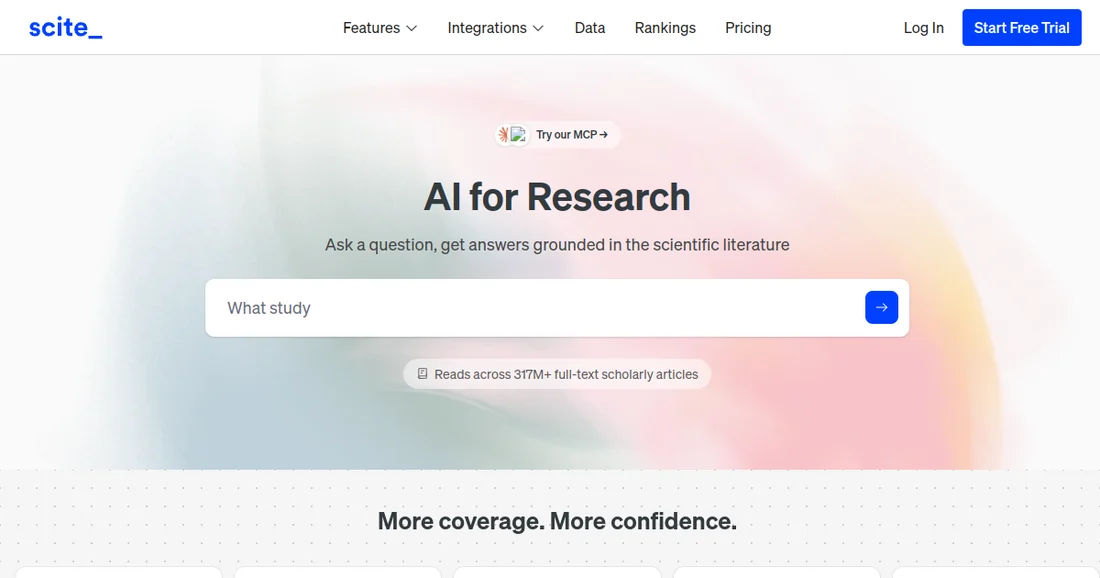
Scite is built around one specific check: whether a widely cited paper's finding has held up as later research responded to it. Scite's homepage describes 'Smart Citations' that 'show how later research has supported, challenged, or discussed a paper, claim, method, journal, author, institution, or funder,' built on 'direct agreements with Wiley, SAGE, and 33+ more publishers' plus the open-access corpus, and states the company is 'now part of Research Solutions,' having indexed more than 1.6 billion citations. Getting access requires an account: Scite's pricing page lists a free 'Connect' tier with 25 monthly credits for use inside chat assistants, a Basic plan at $20 a month billed yearly with full search and 250 monthly credits, and a Pro plan at $50 a month adding API access and 2,500 credits, with a seven-day free trial on the paid tiers.
What the documents show
The homepage states that 'every answer is grounded in real papers, never generated or hallucinated' — a claim about the product's design, not a published error rate or independent audit. Neither the homepage nor the pricing page retrieved here describes the classification step itself as fully automated or as involving human review before a citation is labeled supporting or contrasting; the pages simply state the outcome, not the method behind it. The pricing page's credit system ties every Smart Citation lookup and chat query to a metered allowance rather than unlimited use once signed in.
The friction
A free account gets 25 credits a month, and the vendor does not state on these pages how many credits one citation report or one assistant query consumes, leaving a new user to discover the ceiling by hitting it. The 'never generated or hallucinated' language is a stronger claim than the measured, model-by-model hallucination counts some competing tools publish, and there is no comparable number here to check it against. The ownership note — Scite folded into Research Solutions — is disclosed on the same page but not explained further, which matters for anyone deciding whether to build a workflow around the service long term.
What changed in the work
For someone trying to judge whether a cited claim still stands, Scite's stated design collapses a task that once meant manually pulling every citing paper into a single classified list, which is what the vendor's own pages describe it doing. Whether that list is trustworthy enough to skip the manual check is not something these pages settle; the claim of zero hallucination is the company's own, not an outside party's.
- Does the citation tool disclose how a supporting or contrasting label was decided, or only the label itself?
- How many lookups does the free tier actually allow before a paid plan becomes necessary?
- Would the classification survive a manual check of the two or three citations that matter most to the argument?
Reading the classification as a lead worth checking, rather than a settled verdict, keeps the time saved without asking a metered, unaudited label to carry more weight than the vendor itself claims for it.
Sources & verification
Preserved from the earlier archive. These sources have not all been freshly rechecked for this expansion.
- Scite: AI for Research (homepage)Source date: not stated · Retrieved: 2026-09-16
Describes Smart Citations, publisher agreements, citation index size, and the 'never generated or hallucinated' claim, as read on 16 September 2026.
- Scite pricing pageSource date: not stated · Retrieved: 2026-09-16
Gives the account tiers, credit allowances, and trial terms required to set up and use Scite.
Continue the workflow
- Turn a research question into an evidence table that survives disagreement
A reproducible way for a solo operator or small team to collect evidence, compare conflicting sources, and hand the work to another reader without losing provenance.
- Check PDF extraction before you trust the summary
A quick, repeatable quality check for deciding whether PDF text, tables, and OCR output are reliable enough to feed into notes or summaries.
- Hand off a citation library without handing over a puzzle
A practical Zotero handoff method that preserves attachments and meaning while making the collection understandable to a teammate.
- Elicit measured how often its own summaries invent claims
The vendor's own hallucination study puts a number on a risk most literature-review tools only gesture at.