Historical source and event dates are not site publication dates. Product plans, policies and availability may have changed since retrieval.
The setup
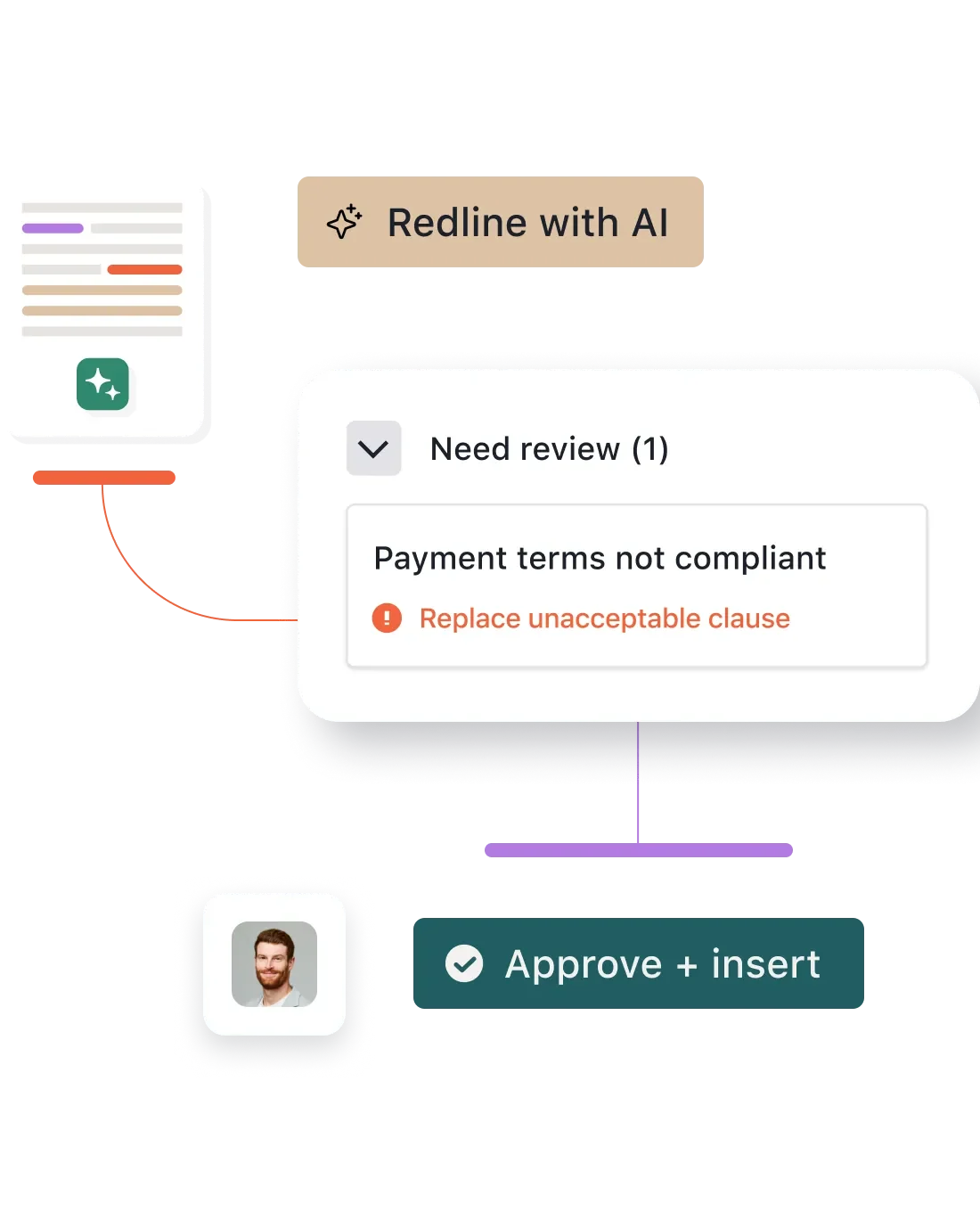
Ironclad's contract-lifecycle platform aims its AI specifically at the review bottleneck rather than drafting from nothing: a legal team first has to configure what the product calls a playbook of preferred language and positions. The vendor's own review-contracts page, current as of 16 September 2026, describes this setup step directly: teams "define preferred language and terms" and "train AI on your unique language and positions" before the review features work against a specific document. A separate AI product page adds that the system ships with "190+ pre-built AI clauses and properties" a team can start from rather than authoring a playbook from zero.
What the documents show
Once a playbook exists, the review-contracts page states the tool can "instantly flag potential risk" and "redline instantly against playbooks with AI Assist and Jurist," producing "legal-approved revision suggestions automatically" and a "first pass redline in seconds." Both phrases describe a first pass, not a final one: the same page lists "accept or reject tracked changes from counterparties" and tagging colleagues for comment as the next steps, which are actions performed by a person, not the AI.
The friction
Ironclad's own site is explicit about a boundary competitors sometimes blur: "Ironclad is not a law firm. Information contained on Ironclad's site does not constitute or contain legal advice, and use of and access to any of the resources contained within Ironclad's site do not create an attorney-client relationship." That disclaimer, combined with the playbook-training requirement, means the tool's usefulness is bounded by how much setup work a legal team already put into defining its own preferred terms; an AI Assist column with no playbook behind it has nothing to redline against.
What changed in the work
The bottleneck the product pages target is the first pass through a contract, not the final judgment call. Read together, the two pages support a kept-or-dropped read: the first-pass flag-and-redline step is what the AI performs, while acceptance, rejection, and any judgment resembling legal advice stays explicitly with the human reviewer, per the vendor's own disclaimer.
- How much of your organization's playbook is actually encoded before you expect useful flags?
- Who signs off on an AI-suggested redline before it goes back to a counterparty?
- Which of the 190-plus pre-built clauses actually match your own contract language?
Ironclad's product pages describe a division of labor rather than an automation of judgment: the AI narrows what a reviewer has to look at, and the reviewer still decides.
Sources & verification
Preserved from the earlier archive. These sources have not all been freshly rechecked for this expansion.
- AI-Powered Contract ReviewSource date: not stated · Retrieved: 2026-09-16
Describes the playbook-training setup step, instant redlining, and the human accept/reject step that follows.
- AI-Based Contract ManagementSource date: not stated · Retrieved: 2026-09-16
Vendor's not-a-law-firm disclaimer and the pre-built clause library detail.
Continue the workflow
- Build a reusable writing brief before polishing the prompt
A compact, reusable specification for commissioning consistent writing without relying on a clever one-off prompt.
- Review the diff for altered facts, not just improved prose
A practical review pass for comparing document versions and finding factual changes hidden inside editorial revisions.
- Hand off an accessible document with structure intact
A human-centered final check for document structure, descriptive links, image alternatives, and usable delivery across formats.
- Docusign now reads the contracts it used to just route for signing
Docusign's own IAM page and Iris blog post, read on 16 September 2026, describe post-signature extraction drawn from a company's full agreement history.