Historical source and event dates are not site publication dates. Product plans, policies and availability may have changed since retrieval.
The setup
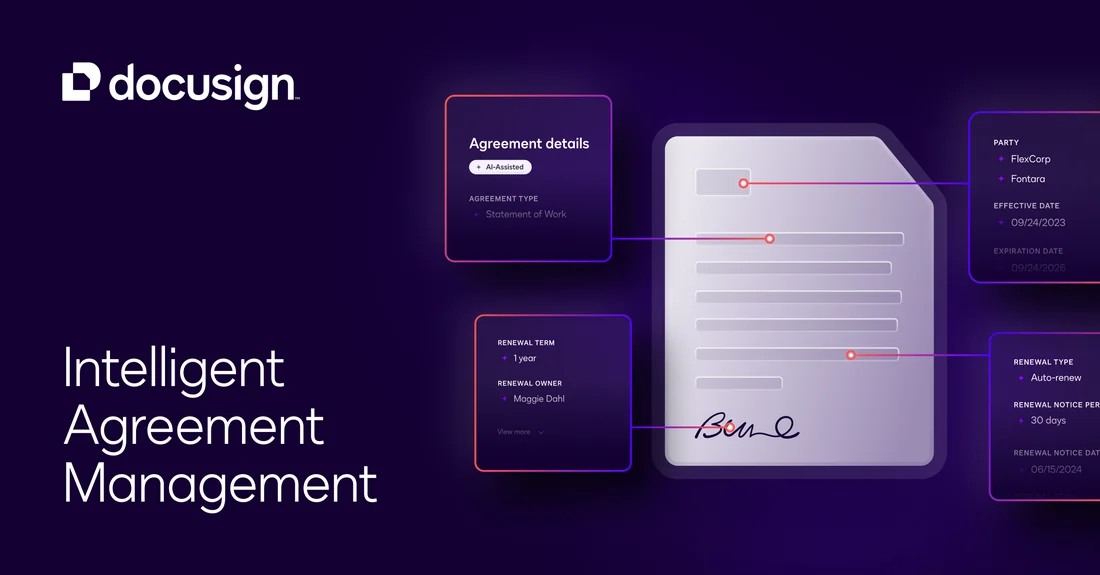
Docusign repositioned its e-signature product as a broader category it calls Intelligent Agreement Management, or IAM. The vendor's own IAM product page, current as of 16 September 2026, frames the shift around three functions, Create, Commit, and Manage, and states that "eSignature is part of Docusign IAM and included in all IAM plans," meaning signature routing is now one component of a larger platform rather than the platform itself. The extraction and analysis capability sits inside a component the company brands Iris.
What the documents show
A Docusign blog post on the Iris AI Assistant and Agents describes what the extraction draws on: Iris is "grounded in your full agreement context," including "your repository of signed agreements, your negotiation history, and your business logic," and can connect to contract data already stored in outside systems such as Salesforce or HubSpot. The stated outputs include surfacing "hidden obligations across hundreds of agreements," autonomously extracting metadata, and calculating future deadlines from contract terms, a shift from signature routing toward mining a company's existing signed-document archive for information nobody had tagged at signing time.
The friction
Neither document states an accuracy figure or an error rate for the extraction, and neither describes a required human-review step before an extracted obligation or deadline is acted on. What the blog post does emphasize is governance rather than accuracy: "Every action is auditable. Every workflow is governed," a framing that shifts the disclosed safeguard from checking the AI's output to logging what it did. The IAM page's plan structure is a second disclosed cost: extraction and agent features live inside IAM plans specifically, not inside a bare eSignature subscription, so a team already paying only for signing must add the broader plan to reach Iris.
What changed in the work
Contracts that once sat as static, signed PDFs become a searchable data source: renewal dates, obligations, and clause language become queryable across a whole repository rather than requiring someone to reopen each file. That is an editorial reading of what the two documents describe together; neither document itself claims a time or cost saving, only the underlying extraction capability and its data sources.
- Which of your existing systems, such as Salesforce or HubSpot, would Iris need access to before it is useful?
- What review step exists before an AI-surfaced obligation or deadline drives a business action?
- Does your current plan include IAM's extraction features, or only base eSignature?
Docusign's own materials describe an expansion from routing signatures to mining what was already signed, with auditability offered as the safeguard in place of a stated accuracy claim.
Sources & verification
Preserved from the earlier archive. These sources have not all been freshly rechecked for this expansion.
- Docusign IAMSource date: not stated · Retrieved: 2026-09-16
Vendor's description of the IAM platform structure, its Create/Commit/Manage framing, and eSignature's place inside it.
- Turn Contract Insights into Action with Docusign Iris AI Assistant and AgentsSource date: not stated · Retrieved: 2026-09-16
Describes what Iris extracts, its data sources, and the governance/auditability framing offered in place of an accuracy claim.
Continue the workflow
- Build a reusable writing brief before polishing the prompt
A compact, reusable specification for commissioning consistent writing without relying on a clever one-off prompt.
- Review the diff for altered facts, not just improved prose
A practical review pass for comparing document versions and finding factual changes hidden inside editorial revisions.
- Hand off an accessible document with structure intact
A human-centered final check for document structure, descriptive links, image alternatives, and usable delivery across formats.
- Ironclad's AI flags contract risk, then hands the call to a lawyer
Ironclad's own product pages, read on 16 September 2026, describe AI-assisted redlining against a trained playbook, with human sign-off kept explicit.