Historical source and event dates are not site publication dates. Product plans, policies and availability may have changed since retrieval.
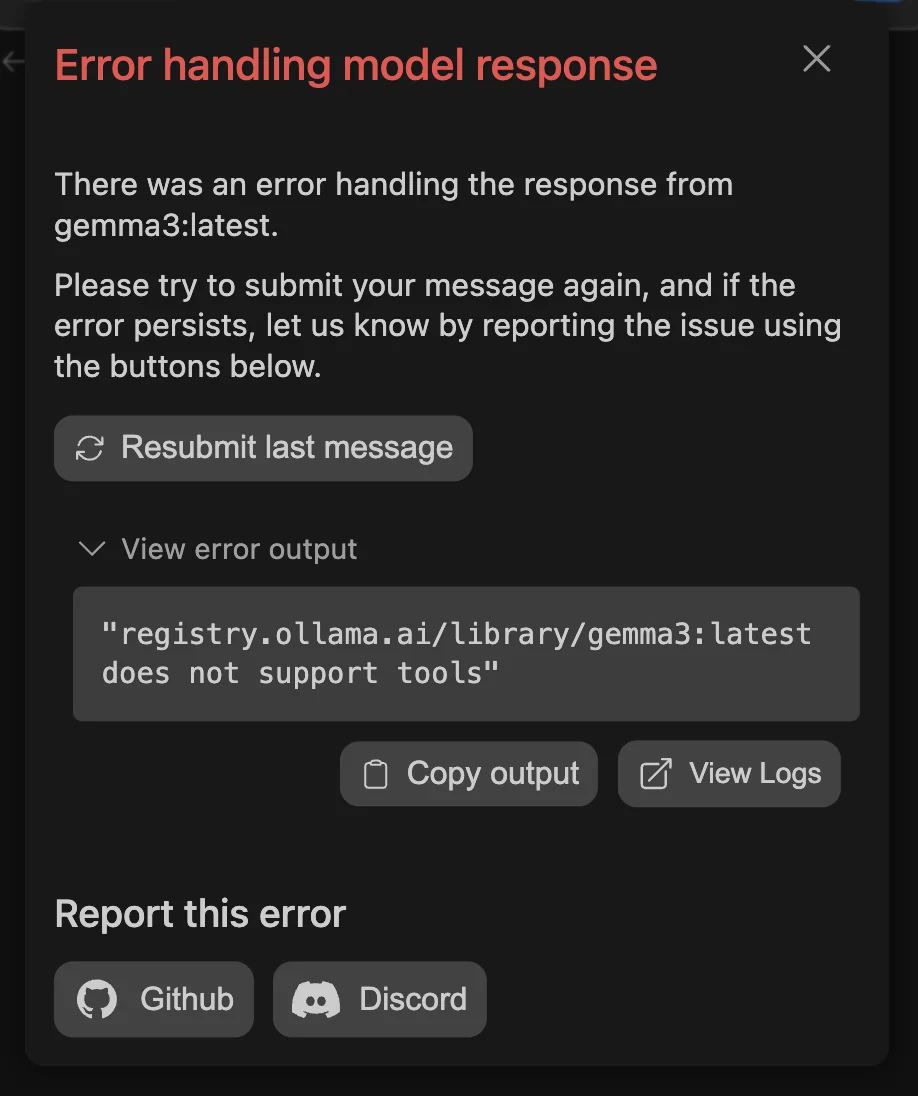
The setup
Continue is an open-source coding-assistant framework rather than a single hosted product, and its model documentation makes that structural choice explicit: a team edits a configuration file to plug in whichever language model handles chat, autocomplete, editing and code-apply roles, rather than accepting one vendor's default. The setup step is choosing and wiring providers per role, from a small set of familiar frontier APIs to a fully local model run on a developer's own machine.
What the documents show
The documentation lists direct support for Anthropic, OpenAI, Gemini, Amazon Bedrock, Azure, xAI, Mistral, and locally run Ollama models, each requiring only an API key or, for Ollama, a locally pulled model file. The Ollama guide frames the local path explicitly as privacy-focused, offline coding assistance, with modest minimum requirements: 8 GB of RAM, more recommended, and 10 GB of free storage. A separate self-hosting guide covers wiring up a custom endpoint through HuggingFace TGI, vLLM or any OpenAI-compatible server, with API-key, custom-header or client-certificate authentication for a private deployment. Together these describe a documented difference in where a prompt and its code travel: to a named third-party API under a hosted setup, or no further than the machine or private endpoint the team runs under a local one.
The friction
The Ollama guide is candid about a specific limitation rather than presenting local models as a drop-in replacement: locally run models have limited tool-calling and reasoning capability, which the documentation says makes Agent mode difficult to use with them. It documents a known failure mode where a local model advertises tool support that does not actually work, producing an Agent-mode error even after a team configures the capability flag the docs recommend. The self-hosting guide's authentication options assume a team capable of managing its own certificates and headers, a setup cost a hosted API key does not carry.
What changed in the work
For a team that cannot or will not send code to a third-party model API, Continue's documented local and self-hosted paths are what make an AI coding assistant usable at all, a genuine before-and-after distinct from cosmetic customization. What the documentation does not support is treating the tool as equally capable in every mode regardless of which model sits behind it: agent-mode reliability is tied to the model chosen, not just to Continue itself, an editorial reading of what the tool-support caveats mean for a team picking a model.
- Which Continue roles, chat, autocomplete, edit or agent, does the team actually need a local model to cover?
- Does the chosen local model's advertised tool support hold up in Agent mode, or only in chat?
- Who manages certificates and endpoint uptime if the team moves from a hosted API key to a self-hosted server?
Continue's own documentation supports the claim that model choice, including a fully local one, is real and configurable rather than aspirational, but the same pages are where the caveat lives: that choice is least reliable in exactly the agent mode a team most wants a coding assistant for.
Sources & verification
Preserved from the earlier archive. These sources have not all been freshly rechecked for this expansion.
- Models | Continue DocsSource date: not stated · Retrieved: 2026-09-16
Lists supported model providers, including Anthropic, OpenAI, Gemini, Bedrock, Azure, xAI and Ollama, and gives per-provider setup steps for hosted and local models.
- Using Ollama with Continue: A Developer's Guide | Continue DocsSource date: not stated · Retrieved: 2026-09-16
States local Ollama models keep code on the developer's machine for offline use, gives minimum hardware requirements, and documents Agent-mode tool-calling limitations for local models.
- How to Self-Host a Model | Continue DocsSource date: not stated · Retrieved: 2026-09-16
Documents self-hosting an open-source model via HuggingFace TGI, vLLM or an OpenAI-compatible endpoint, and the authentication options for a private server.
Continue the workflow
- Reconcile a spreadsheet before writing the story around it
Check an imported or transformed spreadsheet before using its figures in analysis or client work.
- Validate the SQL answer before trusting the sentence
Review an analytical SQL query safely before using its output in a report or decision.
- Review an AI-assisted code change as a change, not a speed claim
Decide whether an AI-assisted patch is safe and maintainable without treating generation speed as evidence of quality.
- Tabnine's air-gapped option still needs one outbound connection
Tabnine's own deployment docs show on-premises coding assistance is real, but a container-registry connection and a locked model list come with it.