Historical source and event dates are not site publication dates. Product plans, policies and availability may have changed since retrieval.
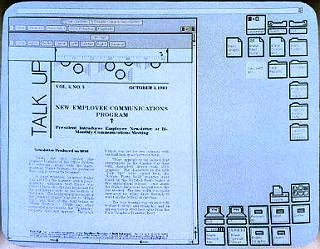
The setup
The Xerox 8010 Information System, commonly called the Star, was first commercially sold in 1981 after development that began in 1977 on Alto-derived hardware codenamed Dandelion. Surviving technical documentation lists a custom AMD 2900 bit-sliced processor, 384 KB of memory expandable to 1.5 MB, a 17-inch display at 1024-by-808 resolution, a two-button mouse and Ethernet networking, running Xerox's own Pilot operating system rather than any software available elsewhere.
What the documents show
The Star's design, per the same documentation, followed four stated principles: seeing and pointing, progressive disclosure, uniformity across applications, and what-you-see-is-what-you-get output, extending the WYSIWYG approach Xerox PARC had already proven with Bravo on the Alto. Files, folders and other functions appeared as icons on a simulated desk, a vocabulary now so standard it is easy to miss how new the terminology was at the time. The Computer History Museum's account of the same PARC research lineage situates the Star's interface choices as a direct continuation of work the museum credits to the Alto project, not an unrelated later invention.
The friction
The documentation is explicit about what the Star lacked and why: it shipped without a spreadsheet application, a gap it calls a major drawback given how popular spreadsheet software had already become, and Xerox kept the system closed by refusing to license its MESA programming environment to outside developers, meaning no third-party software could be written for it at all. Those are not incidental gaps; they describe a fully realized interface sitting inside a locked, single-vendor software ecosystem, a licensing decision the documentation identifies as a specific mistake rather than a neutral design choice.
What changed in the work
What the record supports is that the Star delivered, years ahead of mainstream adoption, an interface vocabulary, icons, windows, a mouse, WYSIWYG documents, that later systems from other companies would popularize. What it does not support is any claim that offices widely adopted this model in 1981; the documented absence of a spreadsheet and the closed licensing describe a product whose designed capability outran what a buyer could actually extend or afford to use. The setup cost here was not learning a new metaphor; it was accepting a single vendor's complete software stack with no path for anyone else to add to it.
- Is a closed platform's limitation a temporary onboarding cost, or a permanent ceiling on what the tool can ever do for this workflow?
- Would this system integrate with the one adjacent task, like spreadsheet math, that it does not natively support?
- Who controls the ability to extend or build on a locked platform, and what does that cost if the vendor's roadmap does not match the buyer's need?
The Star is usually remembered for the interface it popularized rather than the platform decisions that limited it. Both belong in the same account: a design years ahead of its market, closed off in ways that had nothing to do with the interface itself.
Sources & verification
Preserved from the earlier archive. These sources have not all been freshly rechecked for this expansion.
- The Xerox StarSource date: not stated · Retrieved: 2026-09-16
Independent reproduction of period Star 8010 specifications, design principles, and the closed-platform licensing decision, used because Xerox's own original documentation could not be located online.
- Xerox Alto: Computers for “Regular Folks”Source date: not stated · Retrieved: 2026-09-16
Computer History Museum materials situating the Star's WYSIWYG interface as a continuation of the Alto/Bravo research lineage.
Continue the workflow
- Audit knowledge-base access with allowed and denied tests
A minimum-rights test for a small team that checks both useful access and denied access across a shared knowledge base.
- Calculate the total cost of a workflow, not just the subscription
Compare a manual process and an automated alternative without relying on volatile plan prices.
- Run a vendor exit drill before the exit is urgent
Find out whether a team can leave a workflow vendor without losing data, behavior, access, or business continuity.
- Microsoft dropped its 300-seat floor for buying Copilot
Microsoft's own January 2024 announcement removed the seat minimum for Copilot for Microsoft 365, without changing its per-seat price.