Historical source and event dates are not site publication dates. Product plans, policies and availability may have changed since retrieval.
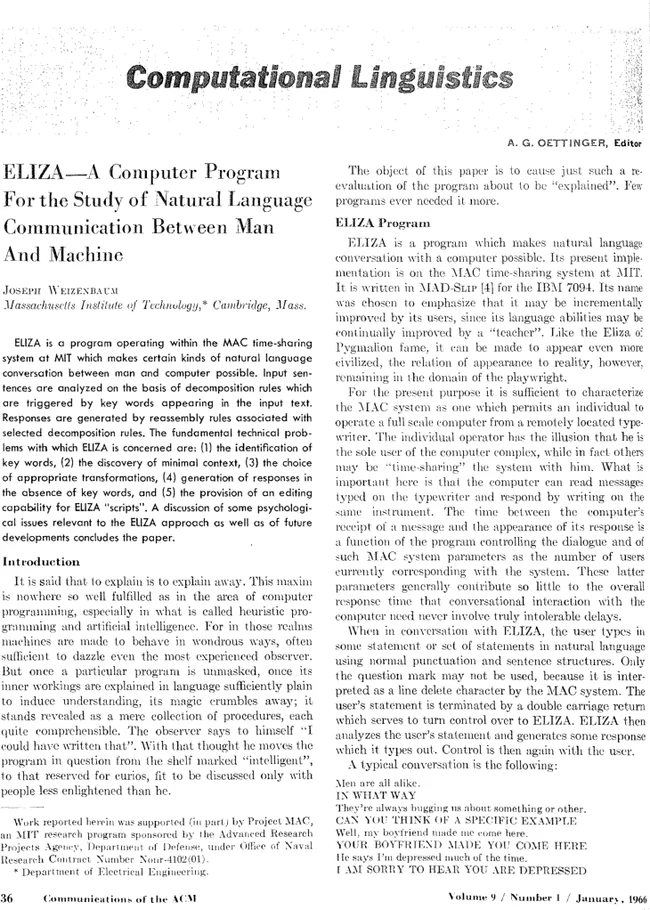

The setup
Joseph Weizenbaum published 'ELIZA: A Computer Program For the Study of Natural Language Communication Between Man and Machine' in Communications of the ACM in January 1966, describing a program built at MIT on the MAC time-sharing system. The paper is a technical writeup aimed at other researchers, not a product announcement; its best-known script simply imitated a Rogerian psychotherapist, a choice Weizenbaum made because that interview style lets the program plausibly assume the pose of knowing almost nothing of the real world without breaking the illusion.
What the documents show
The mechanism, as the paper itself describes it, is decomposition and reassembly rules triggered by keywords: the program isolates a few words from an input sentence and slots them into a template response, ranking keywords so that, for example, "everybody" in a sentence overrides "I." Scripts are data, not code, so the same engine can run in different languages or domains simply by loading a new rule set. Weizenbaum is explicit that this is shallow: the program throws away each of its inputs and has no capacity to reason over what it is told, concealing rather than possessing understanding.
The friction
The paper records its own unease with the reaction it produced. Some correspondents, Weizenbaum writes, were very hard to convince that ELIZA was not human, which he frames as a methodological problem, not a success: the program shows how easily an illusion of understanding, "hence perhaps of judgment," can be created with little machinery. He raises this because credibility judgments about machine output were, in his view, already an area demanding scrutiny before people extended trust further than a program's actual capability warranted.
What changed in the work
The paper supports a narrow, durable point: a system can produce the feeling of being understood using far less machinery than people assume is required, because the credibility comes from conversational structure, not stored knowledge or reasoning. It does not support any claim about the internal workings of today's much larger systems, which the paper obviously never addresses; the parallel modern products draw is with the human reaction Weizenbaum documented, not the technique itself. Treating a fluent chatbot's output as evidence of understanding, without checking what is actually stored and retrievable, repeats the exact gap this paper flagged six decades earlier.
- Can the system point to what it retained from earlier in the conversation, or is continuity an illusion produced by pattern matching on the latest message?
- Would the same fluency survive a question the script or model was never tuned to expect?
- Is trust in the output being extended because of a track record of accuracy, or because the conversational form itself reads as competent?
Weizenbaum's own conclusion was a warning aimed at people, not at machines: the mechanism producing the illusion of understanding was already simple in 1966, and his paper's evidence is that simplicity was sufficient. Nothing about that observation depends on how sophisticated the underlying system later became.
Sources & verification
Preserved from the earlier archive. These sources have not all been freshly rechecked for this expansion.
- ELIZA—A Computer Program For the Study of Natural Language Communication Between Man and MachineSource date: 1966-01-01 · Retrieved: 2026-09-16
Full text of the original CACM paper, used for the decomposition/reassembly mechanism and Weizenbaum's own remarks on the illusion of understanding.
- ELIZA—a computer program for the study of natural language communication between man and machineSource date: 1966-01-01 · Retrieved: 2026-09-16
ACM Digital Library's bibliographic record, archived via the Wayback Machine, confirming the exact publication date and venue.
Continue the workflow
- Prevent duplicate records before an automation goes live
Stop retries, webhook repeats, and double clicks from creating duplicate business records or actions.
- Separate retryable failures from work that needs a person
Keep an automation from hammering a failing service or losing records that cannot complete automatically.
- Design approval gates that reviewers can actually use
Add human review to a consequential workflow without creating blind approvals or permanently stuck runs.
- Release an automation change like a small software change
Change a live automation without discovering mapping or logic errors across the entire workload at once.