Historical source and event dates are not site publication dates. Product plans, policies and availability may have changed since retrieval.
The setup
Dan Bricklin and Bob Frankston built VisiCalc to run on the Apple II, and Bricklin's own site states the program was announced in June 1979 at the Personal Computing Festival during the National Computer Conference. Both creators had prior exposure to row-and-column financial tools before writing VisiCalc, Frankston through timesharing work at Interactive Data Corporation and Bricklin through a Harvard Business School class, background Bricklin's site cites to argue VisiCalc was not the first program to arrange numbers in a grid.
What the documents show
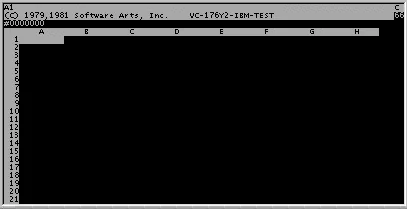
What Bricklin's own account claims as distinctive is not the grid itself but a specific combination: pointing to change a value, instant automatic recalculation of every formula that referenced it, and an interface where input, formatting and output are merged into one program-by-example screen. The executable page on the same site confirms the original ran on the Apple II starting in 1979, with an IBM PC version following in 1981 once that hardware existed. Bricklin frames the recalculation model as the point: a formula entered once could be taught to the computer and then reused by changing only the inputs, rather than reworked with a calculator each time.
The friction
Bricklin's site is candid that VisiCalc's novelty is a bundle, not a single breakthrough, and that prior row-and-column programs existed on timesharing systems costing over a thousand dollars a month or requiring card input, a cost and access barrier VisiCalc removed by running on an affordable personal machine. The site does not supply sales or adoption figures on these pages, and none are claimed here; what it documents instead is a design argument about why an already-known concept needed personal-computer economics before it could spread.
What changed in the work
The documents support treating VisiCalc as the point where a financial modeling task moved from a specialist timesharing terminal to a machine an individual could own and reprogram by editing a cell. Every subsequent spreadsheet AI feature, formula suggestion, natural-language query, autofill, still operates inside that same grid: cells, references, and a recalculation model unchanged since 1979 in its basic contract with the user. Crediting VisiCalc with inventing the row-and-column ledger would overreach what its creator's own site claims; crediting it with making that ledger interactive and personal does not.
- Does an AI spreadsheet feature change the underlying recalculation contract, or just add a natural-language layer on top of the same grid?
- What happens to a formula-heavy sheet when a tool's suggested edit is accepted without checking every cell it touches?
- Is the barrier being removed today, cost or access, the same kind of barrier VisiCalc's affordability once removed?
VisiCalc's real innovation, on this record, was economic and interactive rather than mathematical: the same computation that once needed a timesharing account became something one person could run, watch update, and correct in place. That shift, more than any single formula, is what later tools have kept.
Sources & verification
Preserved from the earlier archive. These sources have not all been freshly rechecked for this expansion.
- VisiCalc: Information from its creators, Dan Bricklin and Bob FrankstonSource date: not stated · Retrieved: 2026-09-16
Bricklin's own site giving the June 1979 announcement date at the National Computer Conference.
- Was VisiCalc the “first” spreadsheet?Source date: not stated · Retrieved: 2026-09-16
Bricklin's own essay explaining what specifically made VisiCalc distinctive: pointing, instant recalculation and a merged input/output interface.
- VisiCalc Executable for the IBM PCSource date: not stated · Retrieved: 2026-09-16
Confirms the original 1979 Apple II release and the 1981 IBM PC version.
Continue the workflow
- Reconcile a spreadsheet before writing the story around it
Check an imported or transformed spreadsheet before using its figures in analysis or client work.
- Validate the SQL answer before trusting the sentence
Review an analytical SQL query safely before using its output in a report or decision.
- Review an AI-assisted code change as a change, not a speed claim
Decide whether an AI-assisted patch is safe and maintainable without treating generation speed as evidence of quality.
- Julius AI computes in an isolated sandbox with a RAM ceiling
Julius's own FAQ names the file types it accepts, the sandbox's memory limit, and a documented tendency for the assistant to hallucinate.