Historical source and event dates are not site publication dates. Product plans, policies and availability may have changed since retrieval.
The setup
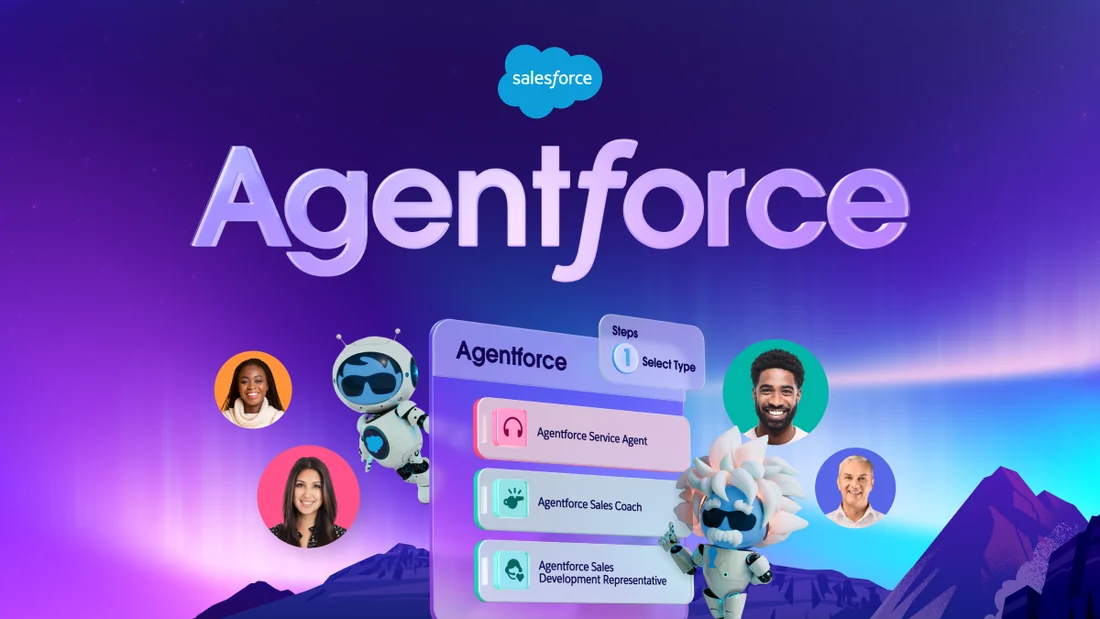
Salesforce announced Agentforce in a press release dated 12 September 2024, describing a platform for building autonomous AI agents that operate inside a company's existing Salesforce data rather than a separate system a team would have to populate from scratch. The release states Agentforce for Service and Agentforce for Sales became generally available on 25 October 2024, and describes the Service Agent as built to replace traditional chatbots that relied on preprogrammed scenarios, while the Sales Development Representative agent is described as engaging prospects around the clock, drawing on CRM and external data already connected to the account.
What the documents show
The press release states the Service Agent can automatically resolve account-access questions and route registration or payment issues to the right resource, and that the Sales agent answers questions, manages objections and schedules meetings. Salesforce's own current Agentforce product page, as it reads today, adds that agents complete proactive tasks within set guardrails and, when faced with an issue beyond their scope, escalate the matter to human agents — a description of the escalation path as a designed feature rather than an occasional fallback.
The friction
The press release attributes a specific figure to a named customer rather than to Salesforce's own measurement: it states Wiley reported an over 40 percent increase in case resolution after deploying Agentforce during a back-to-school period, which is a customer's self-reported result inside a vendor announcement, not an independently audited benchmark, and the release does not disclose Wiley's prior baseline or the comparability of that season to a normal one. The product page's own hand-off description — a summary of the interaction, an overview of the customer's details, and recommendations for what to do next — is Salesforce's description of what a human receives, not evidence of how often that hand-off actually triggers.
What changed in the work
The documents support a specific framing: Agentforce moved some customer-service and sales conversations from a scripted chatbot, which failed by producing a dead end, to an agent designed to either resolve the interaction or hand off with context, which fails by escalating instead. Whether that reduces total human workload, as opposed to changing its shape from full conversations to summarized reviews, is not something either document measures directly, which the editorial read treats as an open question rather than a settled improvement.
- What percentage of this workflow's interactions currently escalate to a human, and is that tracked anywhere the team can see?
- Is a vendor-cited customer statistic, like Wiley's, based on the same measurement the team would use to judge its own deployment?
- What guardrails has the account actually configured, versus what the platform merely makes available?
An agent designed to escalate is not the same claim as an agent that resolves everything, and Salesforce's own materials are careful, in places, to say the former.
Sources & verification
Preserved from the earlier archive. These sources have not all been freshly rechecked for this expansion.
- Salesforce Unveils Agentforce–What AI Was Meant to BeSource date: 2024-09-12 · Retrieved: 2026-09-16
Announcement stating launch and general-availability dates, Service and Sales agent capabilities, and Wiley's self-reported case-resolution figure.
- Agentforce: The AI Agent PlatformSource date: not stated · Retrieved: 2026-09-16
Living product page describing agents completing tasks within set guardrails and escalating out-of-scope issues to human agents.
Continue the workflow
- Prevent duplicate records before an automation goes live
Stop retries, webhook repeats, and double clicks from creating duplicate business records or actions.
- Separate retryable failures from work that needs a person
Keep an automation from hammering a failing service or losing records that cannot complete automatically.
- Design approval gates that reviewers can actually use
Add human review to a consequential workflow without creating blind approvals or permanently stuck runs.
- Release an automation change like a small software change
Change a live automation without discovering mapping or logic errors across the entire workload at once.