Historical source and event dates are not site publication dates. Product plans, policies and availability may have changed since retrieval.
The setup
Dropbox spent its first decade as a place to store files, so a universal search product was a bet that the company's future value sits in finding things across every app a customer uses, not just the files sitting in Dropbox itself. Dropbox's own announcement of Dash for Business, published October 15, 2024, frames the earlier consumer version of Dash, launched the year before, as a smaller step, and positions Dash for Business as AI-powered universal search plus content access control aimed at IT admins as much as end users. It launched in the US, in English only, on web and desktop, with more markets promised for early 2025.
What the documents show
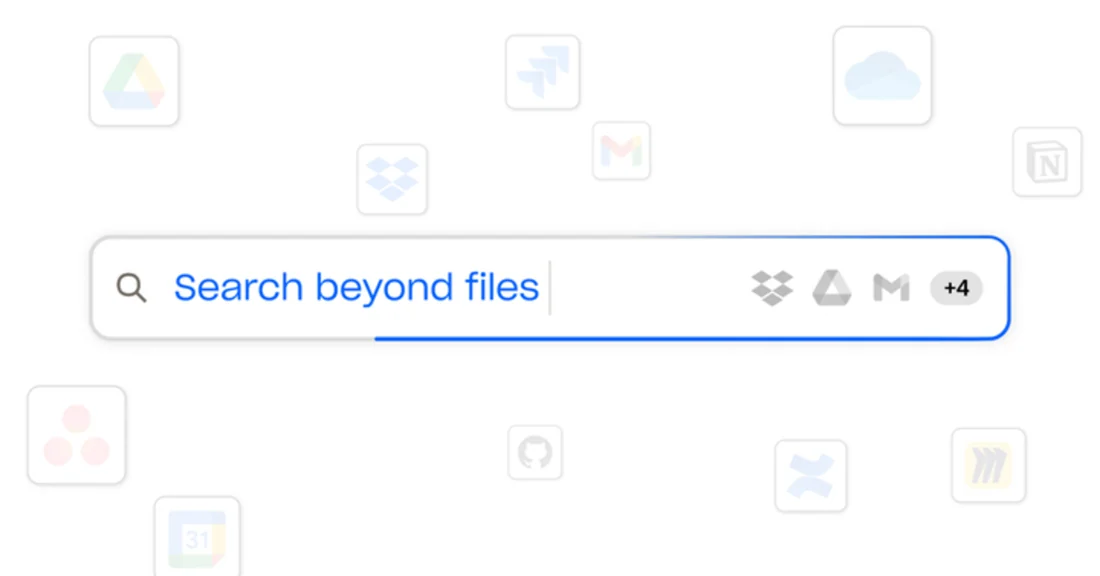
The announcement states Dash for Business is platform agnostic and works with Dropbox, Google Drive, OneDrive, Notion, Asana, and other connected apps, and the current Dash product page lists more than a dozen connected apps including Gmail, Slack, Jira, Salesforce, and GitHub. Dropbox's own account of why it can be trusted with that much cross-app access rests on a specific technical claim: the announcement states Dropbox Dash uses self-hosted AI by default, so customer data stays within what it calls Dropbox's own trust boundary rather than being sent to a third-party AI platform, a claim the announcement makes about its own infrastructure and does not attribute to independent verification.
The friction
Getting broad answers out of Dash for Business depends on how many apps a company actually connects; the announcement itself says the more apps you connect, the more useful Dash becomes, which means the product's value is conditional on an admin granting it access across a company's entire app stack. The announcement also describes the access-control features, built on Dropbox's Nira acquisition, as letting admins find outdated permissions and confidential documents in bulk, which implies the company expects customers to already have a permissions sprawl problem worth surfacing before they even start searching.
What changed in the work
The documented change is architectural: search moves from being a feature of each individual app to a layer that sits above all of them, with Dropbox positioning itself as that layer rather than as one of the apps being searched. A McLaren Racing executive is quoted in the announcement describing visibility into outdated permissions as valuable for protecting intellectual property, a customer's own account of the security benefit rather than an independently measured result.
- How many of the company's actual work apps would need individual connection approval before Dash's cross-app search becomes genuinely comprehensive?
- Does self-hosted AI by default change what data-handling terms apply compared with the AI options used elsewhere in the company's stack?
- Who reviews the bulk permission changes an admin can now make across many documents at once?
Dropbox's own framing treats search, not storage, as the layer worth building next, and its universal-search pitch depends entirely on a company trusting one vendor with read access across many others. That is the trade the announcement asks a business to make, stated in the vendor's own terms.
Sources & verification
Preserved from the earlier archive. These sources have not all been freshly rechecked for this expansion.
- Meet Dash for Business, AI-powered universal search for teamsSource date: 2024-10-15 · Retrieved: 2026-09-16
Dropbox's own launch announcement establishing the October 15, 2024 date, the connected-app search model, the access-control features, and the self-hosted AI claim.
- Dropbox Dash: Find anything. Protect everything.Source date: not stated · Retrieved: 2026-09-16
Dropbox's current product page listing the connected apps Dash indexes as of 16 September 2026, corroborating the breadth of app access the feature depends on.
Continue the workflow
- Build a reusable writing brief before polishing the prompt
A compact, reusable specification for commissioning consistent writing without relying on a clever one-off prompt.
- Review the diff for altered facts, not just improved prose
A practical review pass for comparing document versions and finding factual changes hidden inside editorial revisions.
- Hand off an accessible document with structure intact
A human-centered final check for document structure, descriptive links, image alternatives, and usable delivery across formats.
- Glean's search tool inherits whatever permissions were already wrong
Glean's own security page says it enforces existing access rules rather than fixing them, and pricing is not published.