Historical source and event dates are not site publication dates. Product plans, policies and availability may have changed since retrieval.
The setup
Erik Brynjolfsson wrote 'The Productivity Paradox of Information Technology: Review and Assessment' at MIT's Center for Coordination Science, in a version published in Communications of the ACM in December 1993, a date the publisher's own bibliographic record confirms. The paper is a literature review and assessment, not new experimental data: its stated purpose is to summarize what existing research on computers and productivity had established, separate the central open questions from distractions, and identify what further research could profitably examine.
What the documents show
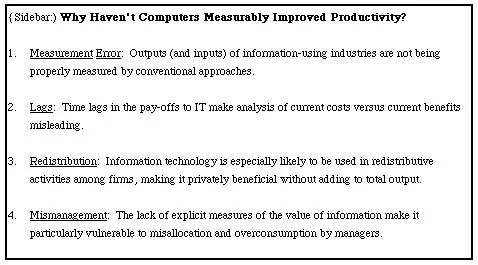
The paper frames the paradox with a line it attributes to economist Robert Solow, that "we see computers everywhere except in the productivity statistics," and reports that delivered computing power in the U.S. economy had increased by more than two orders of magnitude since 1970 while measured productivity, especially in services, appeared stagnant. Brynjolfsson's own assessment is that many of the most-cited claims about this gap do not survive close scrutiny, and he identifies four explanations worth testing rather than endorsing any single one outright: mismeasurement of outputs and inputs, lags from learning and organizational adjustment, redistribution of profits between competitors, and outright mismanagement of the technology.
The friction
The paper is explicit that its first two explanations point to shortcomings in research, not practice, meaning the true benefit of computer investment might already be substantial while existing statistical tools simply fail to capture it, a distinction the paper insists matters for policy. Brynjolfsson also warns his own field directly: because academic studies carefully spell out their limitations while often only the surprising conclusions get reported, researchers must be doubly careful to communicate those limitations, given how much investment decision-making rests on these findings.
What changed in the work
What the paper supports is a specific, named framework, four distinct candidate explanations for a measured gap, that any later study invoking "the productivity paradox" is implicitly adopting or arguing against, not a general observation that technology sometimes disappoints. It does not support any claim that the paradox was later resolved; Brynjolfsson's 1993 text takes no position on outcomes after its publication, and this entry does not supply one either. Citing this paper without naming which of its four explanations is being tested treats a specific argument as a vague slogan.
- Which of the paper's four explanations, mismeasurement, lags, redistribution, or mismanagement, does a current AI-productivity claim actually address?
- Is a cited productivity number a broad economic statistic or a narrower, self-reported survey figure, and does the source keep that distinction clear?
- Would the benefit being claimed today show up in the kind of aggregate data this paper says is poorly suited to detecting it?
Brynjolfsson's paper endures because it named the specific shape of a disagreement rather than settling it. Any study that invokes "the productivity paradox" decades later is still answering to that same four-part structure, whether it says so or not.
Sources & verification
Preserved from the earlier archive. These sources have not all been freshly rechecked for this expansion.
- The Productivity Paradox of Information Technology: Review and AssessmentSource date: 1993-12-01 · Retrieved: 2026-09-16
Full text of the working paper version, used for the Solow quote, the four explanations, and Brynjolfsson's cautions to fellow researchers.
- The productivity paradox of information technologySource date: 1993-12-01 · Retrieved: 2026-09-16
ACM Digital Library's bibliographic record, archived via the Wayback Machine, confirming the December 1993 publication date and CACM venue.
Continue the workflow
- Run a workflow pilot that can answer a real question
Decide whether a proposed workflow deserves wider use using a modest, honest pilot.
- A 1985 congressional report predicted office jobs would stall
The OTA's 1985 study forecasts office automation's effects to 2000 while flagging its own forecasting tools as weak.
- Stanford's AI Index reports numbers it credits to other sources
The annual AI Index compiles labor-market and economy figures from named outside providers rather than measuring them itself.
- McKinsey's AI survey samples opinion, not a random slice of firms
McKinsey's own methodology note describes an opt-in online survey of 1,719 executives, not a probability sample of the economy.